DSOC · Disaster Sciences
Degree programs for the practice of preparedness
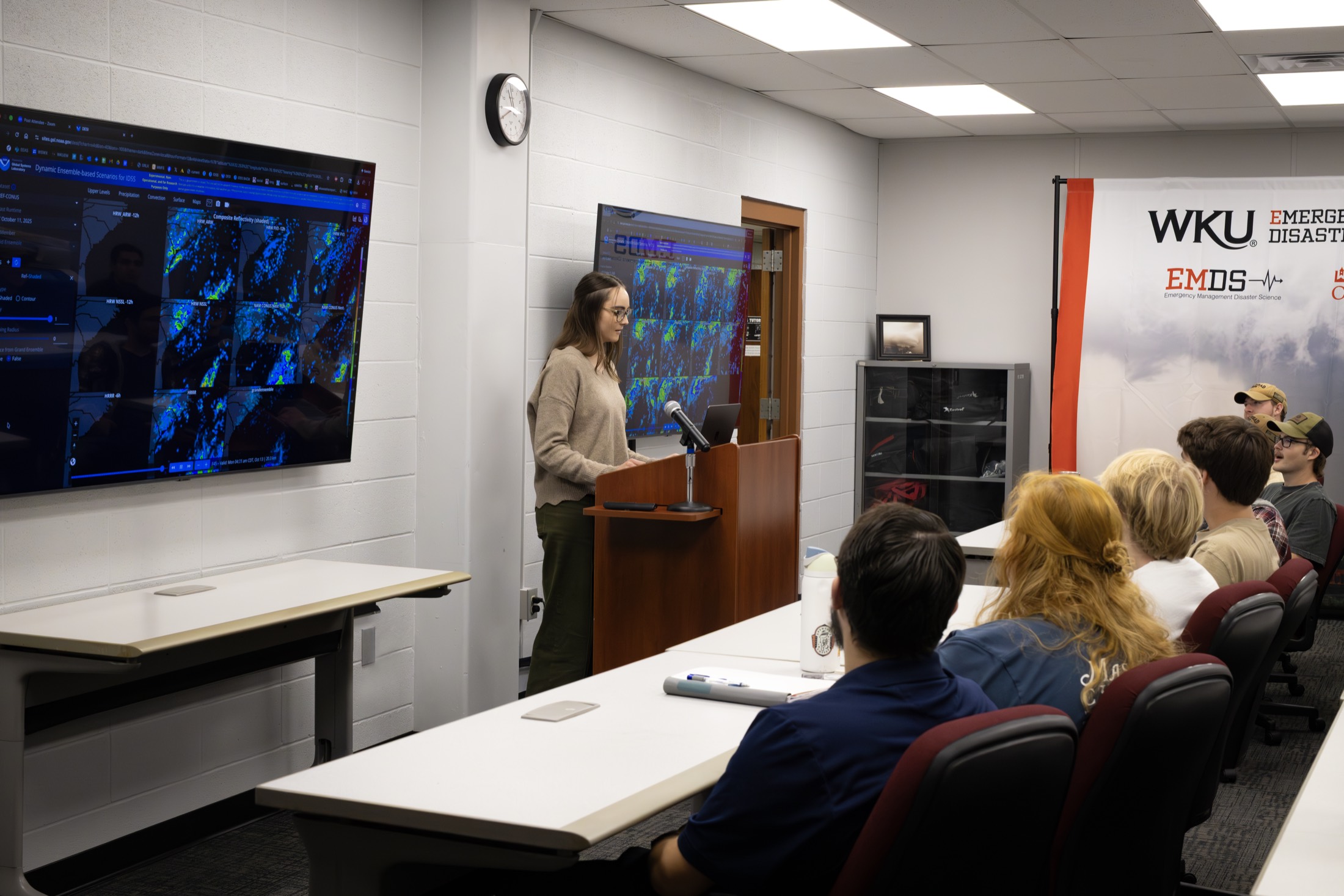
Disaster Science at WKU draws on Meteorology, Geo-Sciences, Environmental Systems, Public Health, and Engineering, focused on every phase of disaster preparedness, mitigation, and response, with a working operations center as the laboratory.
Programs
Three ways in
Meteorology
Launched in 2009 with nine students; today more than 100 strong, with DSOC and CHAOS as hands-on laboratories.
wku.edu/meteorology → Program 02Disaster Science
Preparing students for every phase of disaster preparedness, mitigation, and response, with a working operations center as the laboratory.
wku.edu/eeas → Program 03EMDS Certificates
Emergency Management Disaster Science: a strong technical base in incident management, standalone, or folded into existing master's and doctoral programs.
wku.edu/emds →All three live in the Department of Earth, Environmental, and Atmospheric Sciences (EEAS) within the Ogden College of Science and Engineering.
Companion programs
Credentials that travel across majors
These programs allow EMDS to help fulfill program requirements as a co-credential or related electives.
- Meteorology
- ESGS
- Organizational Leadership
- Criminology
- Sports Rec Management
- Military Science
- Geoscience
- Homeland Security Science
- Public Health
Research & scholarship
The written record
Listings are being compiled and will publish here soon.
Peer-reviewed journal articles
Placeholder: a curated list of faculty and student publications is in progress.
Coming soonOther publications
Placeholder: reports, proceedings, and public-facing science writing will be listed here.
Coming soonFunded grants
Placeholder: active and completed funded projects will be listed here.
Coming soonHow we got here
Fifteen years, four milestones
-
Meteorology Program launches
From a modest starting point of nine students to a program that today has over 100.
-
EMDS certificates added
Emergency Management Disaster Science certificates at both undergraduate and graduate levels, plus an EMDS option within the Homeland Security Sciences master's.
-
DSOC dedicated
Students gain a real operations center for weather and emergency-preparedness support, coursework with consequences.
-
Consortium development begins
Integration across all five WKU colleges: Public Health, Recreation and Sports Management, Leadership, Communications, and Business.
Why it works
Coursework with consequences
These programs position the Department of Earth, Environmental, and Atmospheric Sciences and the Ogden College of Science and Engineering as a world leader in disaster-centric research-to-operations education.
Students don't simulate the work. They staff the storm desk, deploy to national events, and ship decision-support tools that agencies actually use.